The 100K Weekly Blueprint: How to Build a Sustainable Agribusiness with Papaya Farming

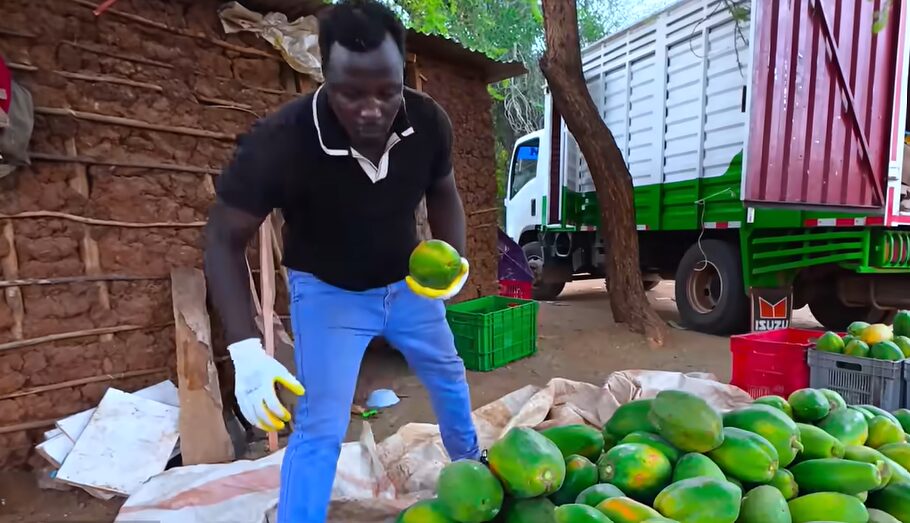
The landscape of modern African agriculture is undergoing a radical transformation, driven by a new wave of resilient entrepreneurs who view the soil not just as a means of survival, but as a sophisticated engine for national wealth. At the heart of this green revolution in Kenya is Alexander Kituku, the visionary director of Star Seeds Limited, whose journey from the crushing weight of repeated agricultural failure to the pinnacle of what many now call the “Papaya Empire” serves as a definitive blueprint for the next generation of agri-preneurs.
In a deeply technical yet inspiring sit-down interview, Kituku pulled back the curtain on the lucrative world of high-value fruit production, specifically focusing on the game-changing Kalina Papaya, also known as the IPB9 variety.
This Indonesian hybrid has become the cornerstone of Kituku’s success, offering a high-performance alternative to traditional indigenous crops that have historically yielded inconsistent results for rural farmers. His story is one of grit, data-driven decision-making, and an uncompromising commitment to quality that has transformed Tharaka Nithi County into a focal point for sustainable agribusiness.
The ascent of the Papaya Empire was paved with the lessons of three devastating failures that would have forced a less determined individual to abandon the field entirely.
Kituku reflects candidly on his early days, noting that his first major setback was rooted in a fundamental lack of genetic understanding. “My first attempt resulted in 630 male plants and only 70 female plants because I used native seeds,” he explains, highlighting the heartbreak of investing labor and hope into a crop that was biologically destined to underperform.
This was followed by a catastrophic encounter with the elements, where he lost an entire season’s harvest to flooding because he had not yet mastered the drainage requirements of the crop. “I didn’t understand then that papayas absolutely don’t like ‘wet feet,'” he notes with the wisdom of hindsight. His third failure came from malnutrition, where stunted, flavorless fruits taught him the expensive lesson that irrigation and manure application are not suggestions, but strict biological mandates. These trials served as his true university, forging a director who understands the pulse of the plant as much as the pulse of the market.
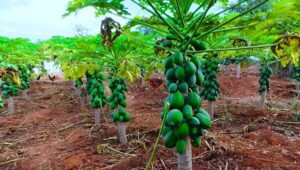
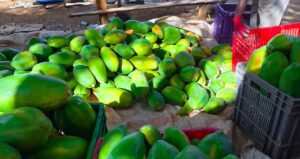
Central to this agricultural resurgence is the Kalina Papaya (IPB9), a variety that Kituku describes as the ultimate “star of the farm” due to its extraordinary efficiency and yield. Unlike traditional varieties that take a year or more to produce, the Kalina hybrid is a marvel of early maturity, beginning to flower just 55 days after transplanting and reaching full harvest readiness within a mere eight months.
“You are not just planting a tree; you are initiating a high-speed production line,” Kituku asserts, emphasizing that the variety’s hermaphrodite nature is its greatest commercial advantage. Because every single plant is self-pollinating and capable of producing fruit, the risk of “dead space” caused by non-fruiting male plants is entirely eliminated.
Furthermore, its dwarf stature is a tactical benefit for the modern farmer; by remaining short, the trees allow for effortless spraying and harvesting, significantly reducing the labor costs and physical risks associated with the towering indigenous papaya trees of the past. Despite their compact size, these plants are powerhouses, with wide, sturdy stems capable of supporting up to 150 fruits simultaneously.
However, Kituku is quick to warn that such high performance is not accidental and requires a meticulous adherence to technical protocols. Success begins beneath the surface, starting with the preparation of the planting holes. He advocates for a spacing of 2m by 2m, ensuring that each plant has its own dedicated territory of 2ft by 2ft by 2ft—though he strongly recommends 3ft depth for those seeking the most robust root penetration and long-term stability.
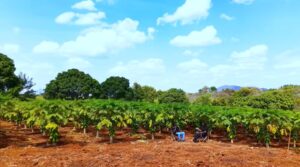
The choice of soil is equally critical; while many farmers are tempted by the dark allure of black cotton soil, Kituku prefers red loam or sandy loam. “Black cotton soil might give you a large fruit to look at, but it often lacks the concentrated sweetness the market demands and is a nightmare for water management due to its tendency to waterlog,” he cautions.
Nutrition must also be balanced with surgical precision, utilizing a soil-to-manure ratio of 2:1. He specifically champions goat or sheep manure for its slow-release nutrient profile, while issuing a stern warning against the excessive use of chicken manure, which can lead to high nitrogen toxicity and total crop loss if mismanaged.
Water management remains the most frequent point of failure for novices entering the Papaya Empire. Kituku insists on a consistent supply of fresh, non-saline water, noting that a single tree requires between 40 to 60 liters twice a week to maintain its physiological health. Salty water is a non-starter, as it permeates the fruit and destroys the delicate brix levels that give the Kalina variety its signature taste. This dedication to precision extends to the “silent killers” of the industry: pests and diseases.
Red spider mites and mealybugs are the primary antagonists in this narrative, yet Kituku offers an organic olive branch to those wary of heavy chemicals. “You can control red spider mites effectively using a simple molasses-to-water ratio of 1:20,” he reveals, proving that high-tech farming can still honor organic principles.
For diseases like powdery mildew and root rot, he recommends a proactive approach using copper-based fungicides or natural alternatives like turmeric, while emphasizing the ethical necessity of respecting Post-Harvest Intervals (PHI) to ensure that the “Empire” only delivers safe, chemical-free produce to the Kenyan consumer.
The economic reality of the Papaya Empire is perhaps its most compelling feature, presenting a level of profitability that rivals many white-collar professions. With a tree lifespan of approximately three years, a farmer can expect a continuous harvesting window of roughly 27 months. The numbers, when scaled, are staggering.
Kituku points out that on a modest 2-acre farm hosting 2,000 plants, a farmer harvesting just one fruit per plant weekly can generate a staggering 100,000 KES per week, assuming a conservative market price of 50 KES per kilogram. “The demand in Kenya is currently so high that we are facing a massive supply deficit,” Kituku explains, adding that buyers are often so desperate for quality produce that they travel directly to the farm gates, eliminating the need for expensive transport logistics for the farmer. This ready market makes papaya farming one of the most secure bets in the current agricultural climate, provided the farmer scales for business rather than subsistence.

For the aspiring agri-preneur, Kituku’s advice is clear: start with quality and think big. He urges farmers to never gamble on uncertified seeds, noting that in Kenya, authenticity can be verified instantly by scratching a KEPHIS label and verifying the code via mobile phone. To attract the lucrative buyers from urban hubs like Nairobi, he suggests a minimum entry point of 500 plants.
“If you have fewer than that, you aren’t running a business; you’re managing a hobby,” he quips. He also stresses the importance of land stewardship, advising against replanting papayas in the same location immediately after a cycle. Instead, he promotes a rotation strategy where the land is rested with nitrogen-fixing legumes like beans or cowpeas for at least a year.
This holistic approach—combining genetic excellence, technical discipline, and market savvy—is what has allowed Alexander Kituku to turn his past failures into a flourishing empire, proving that for those willing to learn from the soil, the rewards are as sweet as the fruit they grow.

Stateupdate Media Group |SMG
Contributor at State Update.
Related News

Chaos in Nyamira: MCAs Locked Out as Speaker Suspends County Assembly for 90 Days

Nyatieko Ward: Calls for Focus on Development and Peaceful Politics

Starehe Boys’ Centre KCSE 2024 Results: Performance Analysis and Grade Distribution

France vs Senegal Prediction & Match Analysis | World Cup 2026

I’m Ready to Accept Defeat in AU Commission Chair Race- Raila Odinga

Systemic Failure or Moral Collapse? Dr. Ombati Outlines Blueprint to End Kenya’s School Unrest Crisis
Latest News

Martha Karua Set to Grace Nakuru as PLP Opens New Offices, Farmers Party Joins Opposition Camp

Ugandans in Kenya Warned After Ruto’s Urgent Directive

Mount Kenya Hawkers Accused of Double Standards Over Ruto’s Foreign Traders Directive: Senator Samson Cherargei Sparks Debate

CS Joho and MP Sudi Deliver Ruto’s Condolences to Tanzania’s President Samia

Kenyans In Burundi Sent A Strong Message By The Government